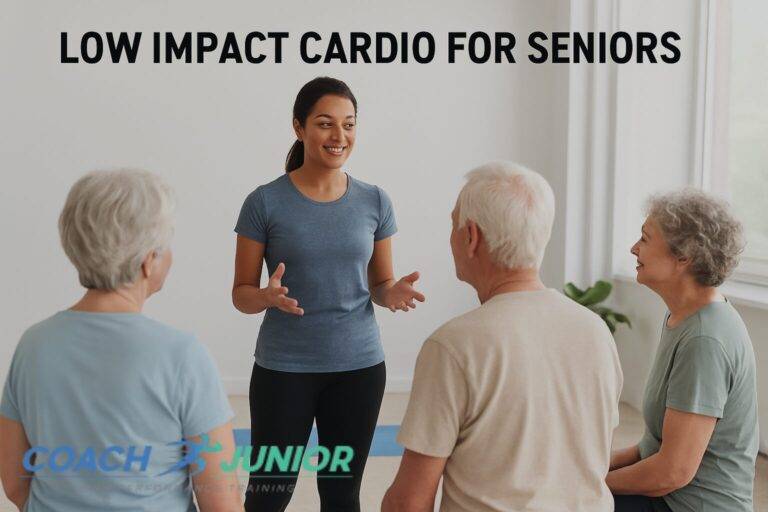
Low Impact Cardio for Seniors — San Francisco | Coach Junior
Stay active and pain-free with Coach Junior. Discover safe, low-impact cardio for seniors in San Francisco—book a free mobility consult today!
Introduction
If you’re reading this, you probably want a smart, safe way to keep your heart strong, joints happy, and balance steady — without pounding on pavements or risking injury. That’s exactly what low impact cardio for seniors delivers. As a coach who trains older adults around San Francisco, I’ve seen how a carefully designed low-impact routine can rebuild confidence, reduce pain, and improve day-to-day energy. This section sets the stage: what low-impact cardio is, why it’s gentle but powerful, and how to use it to stay active and independent.
What Is Low Impact Cardio?
Low-impact cardio is any aerobic activity that raises your heart rate and breathing but minimizes jarring forces through the joints (knees, hips, ankles, and spine). The “low-impact” label usually means at least one foot remains in contact with the ground at all times, or the activity uses an external support (like water or a chair) to reduce bodyweight load.
Common examples include walking, cycling, water-based exercise, seated march routines, and gentle dance. The goal is steady cardiovascular stimulus with predictable, controlled movement patterns — perfect for older adults who want fitness without flare-ups.
Low impact vs. high impact: the difference
Think of high-impact cardio as stomping at a concert — powerful, explosive, and occasionally thrilling — but not ideal if your joints creak. High-impact activities (running, jumping rope, plyometrics) create repetitive shock through bones and cartilage. Low-impact cardio is like dancing to the same beat but with soft shoes: you still move to the rhythm and get your heart working, but your joints feel less of the shock.
High impact: quick, high force, greater injury risk for vulnerable joints.
Low impact: slower force, sustained effort, better for joint longevity.
Why Low Impact Cardio Matters for Seniors
Low impact cardio for seniors isn’t a “soft” alternative — it’s an evidence-based pathway to better health. Here’s where it helps most.
Benefits for heart, joints, balance, and mood
Heart & circulation: Regular moderate aerobic activity strengthens the heart muscle, helps control blood pressure, and improves circulation. That means more energy for daily tasks and lower cardiovascular risk.
Joint health & pain reduction: Gentle, controlled motion nourishes cartilage by increasing synovial fluid flow and reduces stiffness. Water classes and cycling are especially gentle on knees and hips.
Balance & fall prevention: Many low-impact exercises engage the small stabilizer muscles and proprioception (how your body senses position), reducing fall risk. Lateral steps and single-leg balance progressions are gold here.
Mood, sleep & cognition: Aerobic movement stimulates endorphins, helps sleep, and supports cognitive health — important for independence and quality of life.
How low impact differs from high-impact cardio
Low impact focuses on steady, repeatable patterns and often a longer duration at moderate intensity. High impact pursues short bursts of very high load or explosive movement. Both can produce cardiovascular benefit — but low impact trades peak stress for sustainable progress, which typically matches older adults’ goals: longevity, daily function, and feeling well.

Top Low Impact Cardio Options for Seniors
Below are practical, classroom-friendly, and San Francisco-friendly options. Pick two or three you enjoy and rotate them.
Brisk walking (outdoors & treadmill)
Walking is the most accessible low-impact cardio. In San Francisco, choose flatter routes like the Embarcadero, Golden Gate Promenade, or neighborhood greenways when hills feel too steep. On bad weather days or when balance is a concern, use a treadmill (set a slight incline only if comfortable) or indoor mall walking.
Tips:
Use supportive shoes with good cushioning.
Start with 10 minutes and add 2–3 minutes each session.
Try Nordic walking poles for extra upper-body involvement and joint relief.
Water walking & aqua aerobics (pools in San Francisco)
Water slashes weight bearing and offers steady resistance — perfect for arthritis and post-op recovery. Many community pools and YMCAs in San Francisco run senior aqua classes. You’ll get cardio and resistance in the same 45-minute class, often with an instructor who understands older bodies.
Tips:
Chest-deep water is often ideal.
Use pool noodles or water weights for progression.
Ask your local pool about warm water sessions (easier on stiff joints).
Stationary & recumbent cycling
Stationary bikes and recumbent bikes let you control resistance and protect lower-back and knee joints. Recumbent bikes are especially comfortable for people with back pain.
Tips:
Adjust seat so knee is slightly bent at full pedal extension.
Keep the cadence steady (50–70 RPM) for endurance.
Start 10–15 minutes and build to 20–30.
Chair-based cardio & seated marches
Chair cardio is a powerful tool when standing is painful or balance is limited. Seated marches, seated jacks (raise arms while lifting alternate knees), and band rows from a chair increase heart rate safely.
Tips:
Keep spine tall, feet flat, and work at a brisk tempo.
Combine arm and leg movements to increase cardiovascular demand.
Tai Chi, Qigong & gentle yoga
These are low-impact, movement-flow practices that blend breath with motion. Tai Chi improves balance and reduces fall risk; gentle yoga improves mobility and breathing. They’re great complements to higher-tempo low-impact work.
Tips:
Look for “Tai Chi for seniors” or “Chair yoga” classes locally.
Practice 2–3 times per week to notice balance improvements.
Low-impact dance & social cardio
Dance classes tailored for older adults (no complicated turns or jumps) are both social and aerobic. These classes are terrific for motivation and adherence.
Tips:
Choose classes labeled “low impact” or “seniors”.
The social aspect boosts mood and keeps you coming back.

How to Build a Safe, Effective Low-Impact Cardio Session
Design sessions around three parts: warm-up, main set, cool-down. Here’s how to structure a 30-minute session.
Warm-up (5–7 minutes)
Purpose: prime circulation, lubricate joints, and prepare the nervous system.
Gentle marching (1–2 min) — seated or standing.
Arm circles & shoulder rolls (1 min) — mobilize the upper body.
Ankle pumps & hip marches (2 min) — wake up lower limb joints.
Dynamic side steps or slow heel digs (1–2 min).
A proper warm-up reduces stiffness and lowers injury risk.
Main set (intervals, steady-state, or circuits)
Choose one of three structures depending on goals and fitness:
Steady-state (continuous) — keep a moderate pace for 15–30 minutes (walking, cycling). Great for endurance.
Interval style (short bursts) — alternate 1–2 minutes moderate with 30–60 seconds slightly brisker effort; repeat for 12–20 minutes. Increases calorie burn safely.
Circuit (mixed movements) — rotate 5–6 low-impact moves (45 sec work, 15 sec rest) for 2–3 rounds. Works cardio and muscular endurance together.
Example circuit moves: seated march, step-touch, chair sit-to-stand, side leg lift, band row, heel raises.
Cool-down & mobility
Finish with 5–7 minutes to gradually lower heart rate and stretch key muscles:
Slow march 1 minute.
Seated hamstring stretch 30–45 sec per side.
Calf stretch and chest opener 30–45 sec each.
Deep breathing — 1–2 minutes to relax and lower blood pressure.
Cooling down improves recovery and reduces post-exercise dizziness.
4-Week Beginner Plan — Progress Safely in San Francisco
Below is a gentle, progressive plan aimed at beginners who want to build habit and confidence — with rainy-day indoor alternatives for San Francisco’s fog or rainy weeks.
Week-by-week progression
Week 1 — Foundation (3 sessions/week, 10–15 min each)
Session example: 5-min warm-up + 8-min steady chair or walking routine + 2-min cool-down.
Focus: consistency and form.
Week 2 — Build duration (3–4 sessions/week, 15–20 min each)
Add 3–5 minutes to main set. Try one water or treadmill session if available.
Start basic balance drill (single-leg stand with support, 10–20 sec per leg).
Week 3 — Add variety (4 sessions/week, 20–25 min)
Introduce a light interval session (e.g., 1 minute brisk / 1.5 minutes easy).
Include 1 session of gentle Tai Chi or chair yoga for balance.
Week 4 — Progress intensity & mix (4–5 sessions/week, 25–30 min)
Two steady-state sessions, one interval, one dance or water class.
Increase brisk intervals to 60–90 seconds if comfortable.
Reassess: can you talk comfortably during exercise? If yes, you’re in the right zone.
Progression rules: increase total weekly minutes by no more than 10–20% per week; prioritize form over speed.
Alternative rainy-day indoor options
Mall or indoor walking routes (flat, dry).
Chair cardio video or guided seated class.
Recumbent bike or local community center gym for a low-impact session.
At-home circuit using a chair, resistance band, and light weights.

Science-Backed Guidelines: How Much Activity Do Older Adults Need?
Public health bodies provide clear targets for older adults — good guideposts for planning.
CDC & AHA recommendations (moderate vs. vigorous)
150 minutes/week of moderate-intensity aerobic activity (ex: brisk walking, water aerobics) OR 75 minutes/week of vigorous activity (less common for many seniors).
Plus muscle-strengthening activities 2 or more days/week (light resistance bands or bodyweight).
Older adults at risk of falling should include balance training (e.g., Tai Chi) 3 or more days/week.
Moderate intensity: you can talk but not sing. Vigorous: hard to say more than a few words without pausing.
Practical weekly targets for busy seniors
Aim for 3–5 sessions per week of 20–40 minutes (total 150 minutes).
If energy is limited, break into 10–15 minute mini sessions across the day. These add up!
Include 2 short strength/balance sessions per week.
These targets are realistic for San Francisco seniors who want health benefits without extreme time commitments.
Is Low Impact Cardio Right for You? — Quick Screening & Safety Tips
When to check with your doctor
Before starting or increasing activity, check with your physician if you have:
Recent heart attack or unstable angina.
Uncontrolled high blood pressure.
New or worsening shortness of breath.
Recent joint replacement or recent major surgery (get surgeon/physio clearance).
Unexplained dizziness, fainting, or recent falls.
Red flags and pain vs. discomfort
Stop and seek care for chest pain, fainting, severe breathlessness, or sudden swelling.
Modify for pain: mild muscle soreness is normal; sharp joint pain, grinding or swelling is not. Adjust range or switch to seated/water options.
Keep a phone close, have emergency contacts, and consider exercising where staff or a trainer are nearby at first.
Modifications: Joint Replacements, Arthritis & Other Common Issues
Customizing exercise is essential. Here are practical adjustments.
Knee or hip arthritis — best choices and tweaks
Best choices: water walking, cycling, recumbent biking, chair cardio, and gentle walking on flat surfaces.
Tweaks: reduce range of motion on deep bends, slow down tempo, add more warm-up, and choose softer surfaces (mats, tracks). Use trekking poles for extra support during walks.
After joint replacement — timeline and modifications
Follow surgeon and physical therapist guidance first. Generally:
Immediate post-op: short walks, gentle range of motion, and light pool therapy as allowed.
6–12 weeks: progressive strengthening and low-impact cardio increasing with surgeon/physio approval.
Avoid high twisting and heavy impacts until cleared. A trainer experienced with joint-replacement clients can speed safe progress.

Why Local, In-Home Coaching Helps — Coach Junior’s Approach (San Francisco)
Working with a local coach brings practical advantages — especially for older adults with mobility or transportation limits.
Mobility screens, personalized progressions, and caregiver-friendly plans
When I come to a client’s home, the first 30–45 minutes are a mobility screen: we look at walking mechanics, balance, joint range, and daily tasks (stairs, getting out of chairs). From that, I design a progression that fits real life — not a cookie-cutter class. Plans include simple caregiver cues and short video demos so family members can support sessions safely.
Examples of local sessions: parks, pools, and in-home routines
Embarcadero walk + balance drills: flat, scenic, great for motivation.
Pool session at a local community center: water walking and light resistance.
In-home chair cardio + strength circuit: perfect for rainy days or mobility limits.
Local knowledge helps: I can recommend quiet pool times, flatter walking routes in neighborhoods like Noe Valley or the Marina, and accessible community center classes near your home.
Common Mistakes & How to Avoid Them
Doing too much too soon
Many seniors get excited and push too hard on day one. Avoid injury by following the 10–20% rule (don’t increase total weekly minutes by more than 10–20% each week) and prioritizing form over duration.
Ignoring balance and strength work
Cardio is great, but balance and strength training reduce falls and keep mobility. Pair aerobic sessions with 10–15 minutes of strength or balance work 2–3 times a week.
Call to Action — Book a Free Mobility Consult in San Francisco
Want a safe, personalized plan for low impact cardio for seniors tailored to your neighborhood and needs? Book a free 15-minute mobility consultation with me in San Francisco — I’ll walk you through a short screening, recommend your best local class/pool options, and build a 4-week starter plan you can actually stick with.
Conclusion
Low-impact cardio for seniors is practical, proven, and adaptable. Whether you prefer a brisk walk along the waterfront, a warm water pool class, or a chair-based routine in your living room, the most important step is choosing movement that feels safe and enjoyable. Build gradually, prioritize balance and strength, and seek local support when needed — and you’ll be surprised how quickly walking to the corner store or climbing a single flight of stairs becomes easier and more enjoyable.
FAQs
How often should a senior do low-impact cardio each week?
Aim for about 150 minutes of moderate activity per week (e.g., 30 minutes × 5 days), but if that feels like too much, start with shorter sessions (10–15 minutes) and build up. Consistency is more important than intensity.
Is water aerobics better than walking for seniors with knee arthritis?
For many with knee arthritis, water aerobics is gentler because the pool supports bodyweight and reduces joint loading — making movement less painful and often more enjoyable.
Can I get a good cardio workout while seated?
Yes. Seated marches, seated jacks, and combined arm/leg moves can raise heart rate meaningfully and are great for people with balance or mobility limitations.
How do I know if my exercise intensity is “moderate”?
Use the talk test: during moderate activity you can talk but not sing. Another way is perceived exertion — a 5–6 out of 10 feels moderate.
Where can I find trusted low-impact classes or trainers in San Francisco?
Look for senior programs at YMCA branches, community centers, local pools, Silver Sneakers partner locations, or book an in-home consult with a certified trainer who has experience with older adults. If you’d like, I can recommend or set up a free mobility consult to assess your needs and point you to the best local options.