
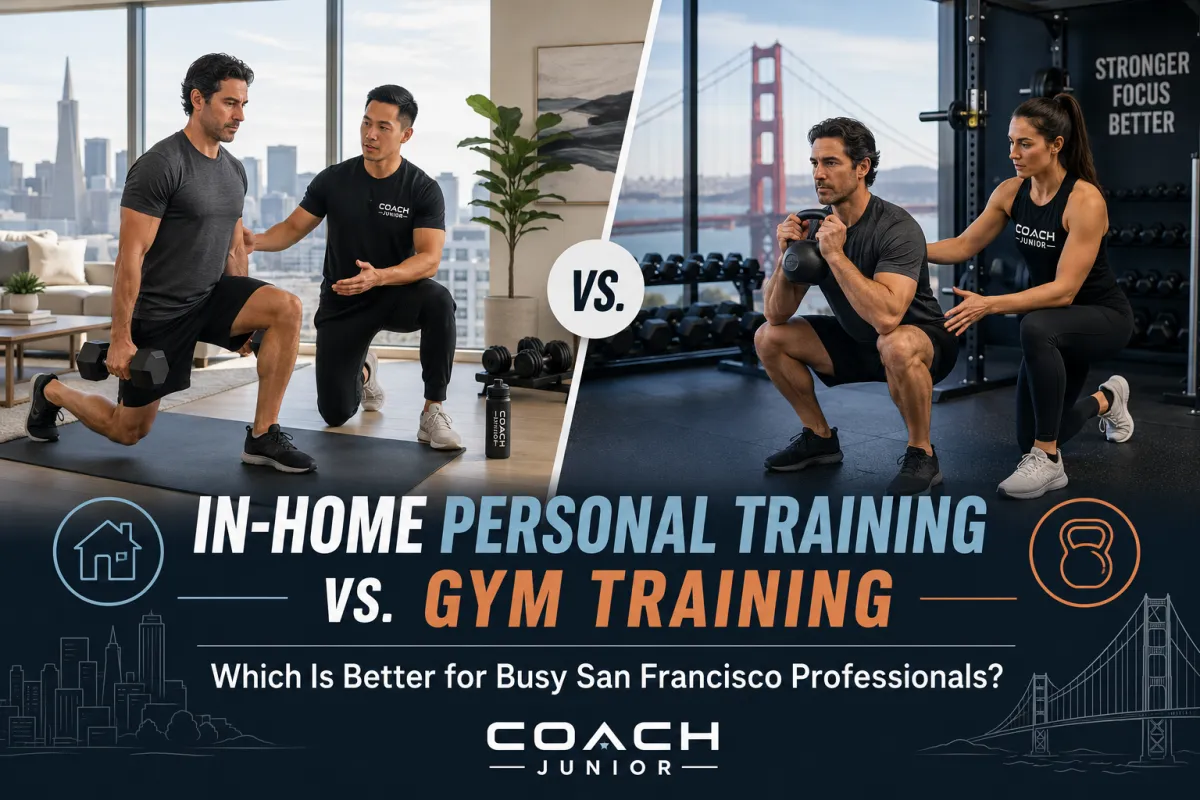
Which Is Better In-Home Personal Training vs. Gym Training
Living and working in San Francisco can make maintaining a consistent fitness routine challenging. Between long workdays, meetings, commuting, family responsibilities, and social commitments, finding time to get to the gym is often easier said than done.
That is one reason many professionals are reconsidering what personal training needs to look like.
Instead of arranging their schedule around a gym, some are choosing personal training at home, where a trainer comes directly to them. Others still prefer the equipment, atmosphere, and routine that come with training at a traditional gym.
Neither option is automatically better for everyone. The right choice depends on your schedule, fitness goals, training preferences, and what will help you remain consistent over time.
Below, we compare in-home personal training with gym training to help busy San Francisco professionals determine which approach may fit their lifestyle best.
What Is In-Home Personal Training?
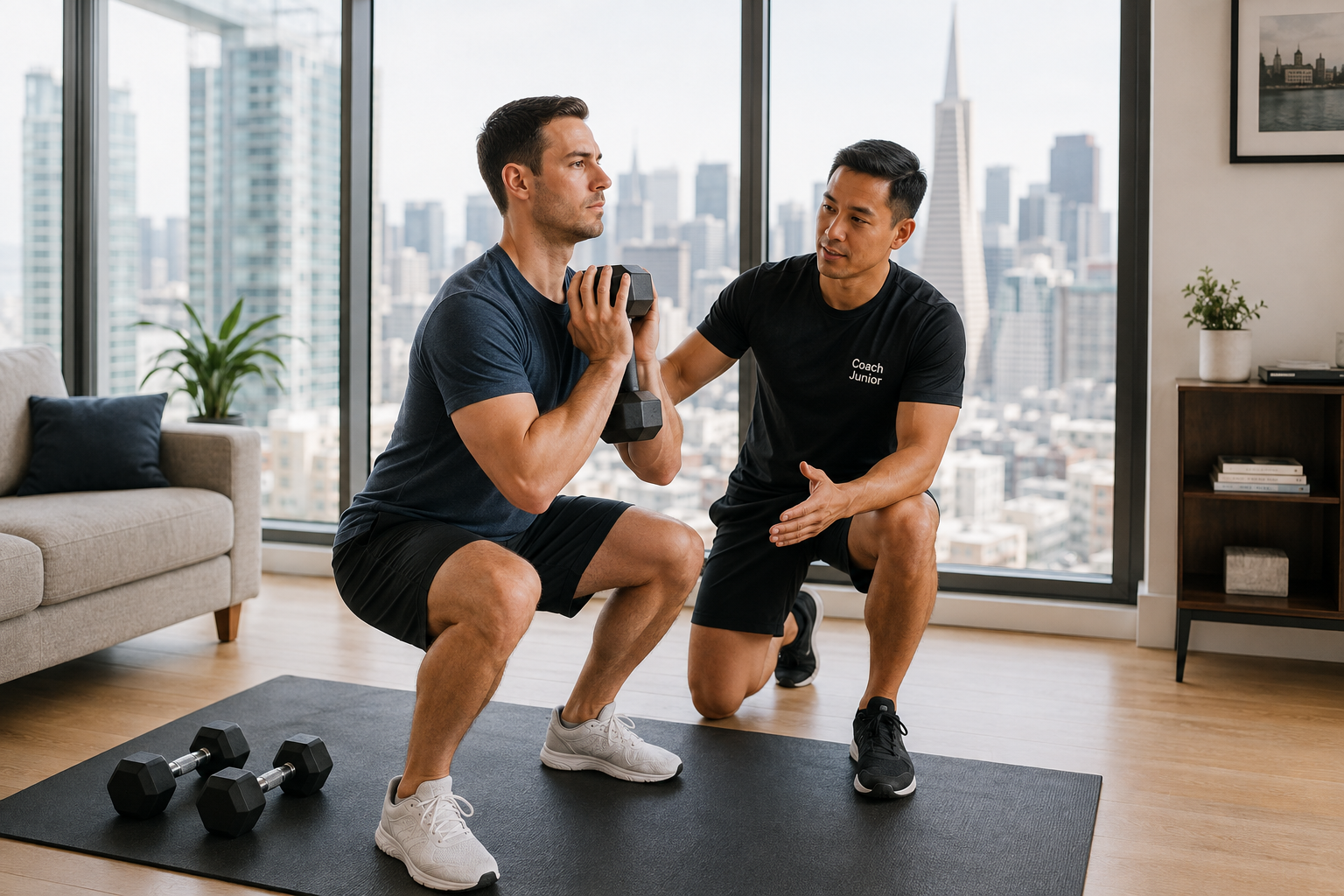
In-home personal training brings professional fitness coaching directly to your home.
Instead of commuting to a fitness facility, changing in a locker room, waiting for equipment, and traveling home afterward, your workout happens in a familiar environment and on a schedule designed around your day.
An experienced in home personal trainer can design workouts around your available space, current fitness level, equipment, movement ability, training history, and personal goals.
And you do not necessarily need a fully equipped home gym.
Depending on your personal fitness program, sessions can incorporate:
Bodyweight exercises
Resistance bands
Dumbbells or kettlebells
Mobility exercises
Strength and conditioning movements
Balance and stability work
Cardiovascular exercises
Core training
The focus is less on how much equipment you have and more on selecting appropriate exercises, using proper technique, and progressing your training effectively.
For busy professionals, working with a personal fitness trainer at home can make structured exercise considerably easier to fit into a demanding schedule.
What Is Gym-Based Personal Training?
Gym-based personal training takes place in a commercial gym, private training facility, or fitness studio.
You still receive guidance from a personal trainer, but sessions typically make greater use of the equipment available at the facility.
That may include:
Cable machines
Barbells and weight plates
Squat racks
Cardio machines
Resistance machines
Specialized strength equipment
Larger selections of dumbbells and kettlebells
For people who enjoy the traditional gym environment or have goals that require access to specialized equipment, gym training can be an excellent option.
The main difference is that you need to travel to the facility and fit your workout around its location, operating hours, and environment.
In-Home Personal Training vs. Gym Training: Key Differences
Both in-home and gym-based personal training can provide effective coaching, but the experience is different. The better option depends on your schedule, training goals, and preferred workout environment.
In-Home Personal Training
In-home personal training is a strong option for busy professionals who value convenience and privacy. Your trainer comes to your home, so there is no need to spend additional time commuting to and from a gym.
Key benefits include:
No travel time before or after your workout
Greater privacy and fewer distractions
Flexible scheduling for busy professionals
No waiting for machines or equipment
Personalized workouts based on your available space and equipment
A comfortable environment for beginners or people returning to exercise
Easier integration of fitness into a demanding work schedule
For professionals with limited time, personal training at home can make maintaining a regular exercise routine more practical.
Gym-Based Personal Training
Gym training may be a better fit for people who enjoy a traditional fitness environment or need access to a wider variety of equipment.
Key benefits include:
• Access to strength machines, cable systems, barbells, and cardio equipment
• Greater equipment variety for advanced strength training
• A dedicated environment for exercise
• The energy and motivation of training around other people
• More options for specialized resistance and performance exercises
If your gym is conveniently located near your home or workplace, gym-based personal training can also fit well into your routine.
Which One Is More Convenient?
For most busy San Francisco professionals, in-home training has an advantage when it comes to convenience.
Gym routine: Work -> commute -> gym -> workout -> commute home
In-home routine: Work -> workout at home -> continue your evening
Removing the commute and other gym-related logistics can make it easier to remain consistent with your personal fitness program.
Why In-Home Training Works Well for Busy San Francisco Professionals
For busy professionals, one of the biggest obstacles to fitness is often not motivation - it is logistics.
A workout may take 45 or 60 minutes, but once you include traveling to the gym, parking or transportation, changing clothes, waiting for equipment, showering, and getting back home, the overall time commitment can become considerably longer.
This is where personal training at home offers a significant practical advantage.
You Remove the Commute From Your Workout
With in-home training, your trainer comes to you.
If you have an early meeting, a packed afternoon, or evening commitments, removing travel from your workout can make training much easier to integrate into your day.
Your 60-minute training session can remain much closer to an actual 60-minute commitment.
For professionals whose calendars regularly change, that convenience can make a meaningful difference in long-term consistency.
More Privacy and Fewer Distractions
Not everyone enjoys crowded gyms.
Some people feel uncomfortable exercising around large groups, while others simply prefer to train without waiting for machines, dealing with distractions, or navigating a busy fitness floor.
Training at home provides a more private environment where your personal training coach can focus the session entirely on your needs.
This can be particularly valuable for:
Fitness beginners
Professionals with limited training experience
People returning to exercise after a long break
Older adults
People who prefer privacy
Individuals working on mobility or movement quality
Anyone who finds traditional gyms intimidating
Instead of worrying about what everyone else is doing, you can focus on learning proper movement and progressing at your own pace.
Personalized Training for Your Goals
A major advantage of working with a certified personal trainer is having a program tailored to your individual needs rather than following a generic workout routine.
A well-structured personal fitness program may consider factors such as:
Current fitness level
Training history
Strength
Mobility
Lifestyle
Available time
Recovery
Personal goals
For one person, that might mean improving strength and body composition.
For another, it could mean becoming more mobile after spending much of the workday sitting at a desk.
A runner may need strength, stability, and mobility work to complement running sessions.
Someone in their 50s or 60s may prioritize maintaining muscle, balance, movement confidence, and long-term physical independence.
The most effective training plan is not necessarily the most complicated one. It is the one that is appropriate for your needs and realistic enough to maintain consistently.
Training Can Fit Around Your Work Schedule
One of the most important questions for a busy professional is:
Can I realistically maintain this routine for the next six months?
A workout program is only useful when you can consistently follow it.
Imagine you regularly finish work at 6:00 p.m. With gym training, your evening can involve commuting, waiting for equipment, completing your session, and then commuting home. With in-home training, you can move directly from work into your workout and then continue your evening.
For executives, entrepreneurs, remote employees, parents, and professionals with unpredictable calendars, reducing the number of steps required to exercise can make the routine considerably easier to maintain.
For someone looking for a personal trainer in San Francisco, scheduling convenience can therefore be just as important as the type of workout itself.
When Gym Training May Be the Better Choice
In-home personal training has clear advantages, but gym training still makes sense for many people.
You Want Access to More Equipment
A commercial gym usually offers considerably more equipment than a home training environment.
This may be beneficial if your program requires:
• Heavy barbell training
• Specialized resistance machines
• Multiple cable stations
• Specific cardio equipment
• Advanced strength equipment
Although an effective workout does not require dozens of machines, greater equipment variety can be useful for certain performance and advanced strength goals.
You Enjoy the Gym Environment
Some people genuinely enjoy going to the gym. The music, energy, other people training, and separation between home and exercise can create motivation.
If physically going somewhere helps put you into training mode, the gym environment may improve your consistency rather than reduce it.
The Gym Is Already Convenient
If your gym is inside your apartment building, close to your workplace, or directly on your normal route, the convenience difference may be relatively small.
In that situation, gym training with a qualified personal trainer can work extremely well.
Can You Get an Effective Workout at Home With Minimal Equipment?
A common misconception is that effective personal training requires a room filled with expensive fitness equipment.
For many general fitness goals, it does not.
A skilled trainer can manipulate several variables to make exercises easier or more challenging, including:
Resistance
Repetitions
Sets
Tempo
Range of motion
Exercise selection
Rest periods
Stability demands
Movement complexity
A few dumbbells, resistance bands, and bodyweight exercises can provide significant training variety when programmed correctly.
As your strength develops, additional equipment can also be introduced when appropriate.
This means a well-designed personal fitness program can be effective even when training space and equipment are limited.
In-Home Training for Professionals Who Sit Most of the Day
Many San Francisco professionals spend substantial portions of their workday at a computer.
A personalized exercise program can therefore include more than traditional strength exercises.
Depending on your needs, sessions may incorporate exercises designed to improve:
Hip mobility
Shoulder mobility
Core control
Upper-back strength
Lower-body strength
Balance
General conditioning
Overall movement quality
The objective is not simply to make a workout difficult. It is to develop a program that supports the way you actually live, work, and move.
Working with a personal fitness trainer at home also allows your trainer to understand your actual training environment and design sessions accordingly.
In-Home Training Can Also Complement Running
San Francisco has a strong running culture, and many professionals combine running with strength training.
However, running and strength training do not need to compete with each other.
A personalized program can complement your running schedule with work focused on:
Lower-body strength
Core stability
Single-leg control
Hip and ankle mobility
Balance
Running-specific conditioning
Recovery
Combining running with appropriate strength training can create a more balanced approach to fitness and performance.
Is In-Home Personal Training Only for Beginners?
No. Home training can be adapted for a wide range of abilities.
Beginners
Beginners can learn exercise technique and build confidence in a private environment without feeling pressured by a busy gym.
Intermediate Clients
Training can progress through additional resistance, more challenging movements, structured programming, and increased training volume.
Experienced Clients
More experienced clients can use targeted strength, conditioning, mobility, and performance sessions alongside independent workouts, running, cycling, or other activities.
The location of your workout does not determine the quality of your program.
Programming, progression, coaching, effort, and consistency matter far more.
Which Option Is Better for You?
Consider in-home personal training if you:
• Have a demanding or unpredictable work schedule
• Want to minimize travel time
• Prefer privacy
• Want one-on-one coaching
• Struggle with gym consistency
• Prefer exercising at home
• Want training personalized around your lifestyle
• Are restarting exercise and want additional guidance
Consider gym training if you:
• Enjoy the energy of a gym
• Need extensive strength equipment
• Want access to specialized machines
• Already have a conveniently located gym
• Prefer separating your workout environment from your home
There is no universal winner.
The best training environment is the one that allows you to train effectively and consistently.
Consistency Matters More Than Location
It is easy to spend too much time searching for the perfect workout.
In reality, a well-designed program performed consistently will usually be more valuable than an advanced program you rarely have time to complete.
For a busy San Francisco professional, convenience can therefore become part of your fitness strategy.
When exercise fits naturally into your schedule, there are fewer logistical barriers between you and your workout.
That is where in-home training can be particularly valuable.
You still receive professional coaching and structured programming, but instead of reorganizing your entire day around fitness, fitness can be designed around your life.
Train on Your Schedule With Coach Junior
If getting to the gym repeatedly falls to the bottom of your schedule, bringing personal training to you may be a more practical solution.
Coach Junior provides personalized training for clients in San Francisco, with programs built around fitness level, goals, schedule, movement ability, and lifestyle.
Whether your goal is to build strength, improve mobility, support your running, manage your weight, improve conditioning, or simply create a fitness routine you can maintain, the focus is on developing a practical and sustainable training plan.
If you have been searching for a personal trainer in San Francisco who can provide individualized coaching without requiring another trip across the city, in-home training may be worth considering.
Ready to make fitness fit your schedule?
Schedule a fitness assessment with Coach Junior and explore a personalized training approach designed around your goals and lifestyle.
Frequently Asked Questions
Is personal training at home effective without gym equipment?
Yes. Many strength, mobility, balance, and conditioning exercises can be performed using bodyweight, resistance bands, dumbbells, kettlebells, and other compact equipment. Your trainer can adjust the program as your fitness level progresses.
How do I choose an in home personal trainer near me in San Francisco?
Look for a trainer whose experience, coaching approach, availability, and services match your goals. You may also want to consider qualifications, how programs are personalized, whether the trainer works in your neighborhood, and whether their schedule fits your routine.
Do I need a large room for in-home personal training?
Not necessarily. Many exercises require relatively little space. A trainer can select movements and equipment based on the area available in your home.
Should I work with a certified personal trainer?
Professional qualifications can be an important consideration when choosing a trainer. You should also consider relevant experience, communication style, programming approach, and whether the trainer can adapt sessions to your individual goals and abilities.
Is an in-home personal trainer suitable for beginners?
Yes. Private training can be particularly helpful for beginners because the trainer can focus on exercise technique, appropriate progression, and building confidence without the distractions of a crowded gym.
How often should I work with a personal training coach?
The right frequency depends on your goals, experience, schedule, recovery, and how much independent exercise you perform. A personalized program should establish a realistic training frequency that you can maintain consistently.