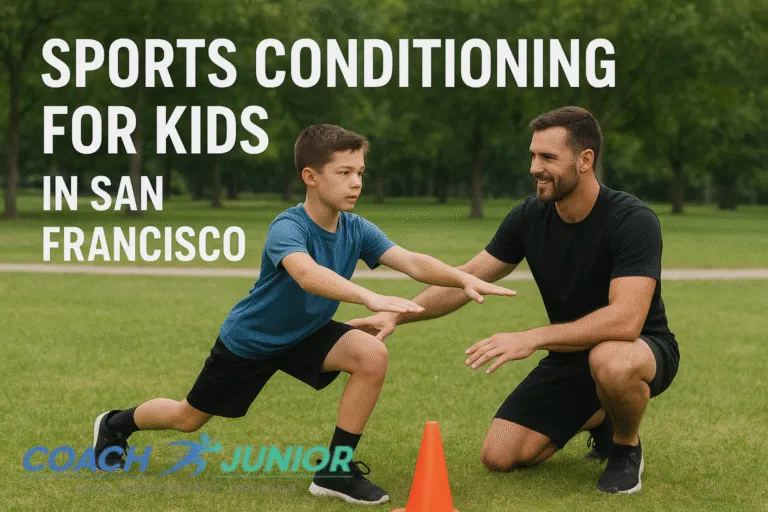
Sports Conditioning for Kids in San Francisco | Safe, Science-Backed
If you’re a busy parent in San Francisco searching for sports conditioning for kids in San Francisco, you want two things: results and safety — fast. You also want convenience: a coach who can show up at your living room, the nearest park, or run a tight, effective virtual session. Welcome to the no-fluff guide that explains exactly what smart youth conditioning looks like, why it matters more than “more practice,” and how Coach Junior delivers evidence-based, playful, and local programs across SF neighborhoods. Think of this as your coach-in-the-pocket: practical, science-friendly, and written for parents who want their kids to thrive.
What “sports conditioning for kids” really means?
At its core, sports conditioning for kids is not just “extra practice” or “tougher drills.” It’s a development-first training plan that teaches young athletes how to move — how to accelerate, decelerate, land, stabilize, and produce power — so sport skill practice actually sticks and the body stays healthy.
This kind of conditioning blends:
Movement literacy (how to hinge, squat, and land safely)
Mobility (range of motion that supports good technique)
Strength and stability (bodyweight and progressive resistance), and
Speed, agility & power (short, high-quality efforts that transfer to game situations).
Why does this matter? Because two kids can practice dribbling for 10,000 hours — but the one who learns how to move efficiently will win in games and stay on the field longer. Coach Junior focuses on this transfer: every drill has a purpose that links directly back to performance and injury prevention in San Francisco’s parks, playgrounds, and living rooms.
Why the right conditioning matters more than “more practice”
Have you ever seen a kid who trains non-stop but still gets hurt or plateaus? That’s because “more practice” without proper conditioning often reinforces poor movement patterns. Conditioning teaches the hardware (muscles, joints, and nervous system) to support the software (sport skills).
Think of it like a phone: practicing is installing apps; conditioning is keeping the battery healthy and the OS updated. Apps run better when the OS is optimized. Likewise, your child’s skills will be more reliable when their body is trained to move efficiently.
Key payoff: Less overuse injury, better in-game decision-making under fatigue, and visible improvements in speed and power — not just skill repetition.
How conditioning for kids differs from adult training
Kids aren’t small adults. Training for children prioritizes:
Play-first learning (games > repetitive sets)
Low external load (bodyweight → bands → light resistance only when ready)
Shorter, frequent sessions (attention span is a real limiter), and
Skill variability (multi-sport movement exposure).
Adults might chase PRs and heavy loads. For kids, we chase movement competency, confidence, and progressive exposure to loads — all supervised and individualised. Coach Junior uses development-based progression — not arbitrary weights or adult-style conditioning — delivering safer, longer-lasting gains.
Who benefits — which kids should do sports conditioning?
Almost any child who plays sports or is active benefits. But the type of conditioning varies.
Age groups & goals: 6–9, 10–13, 14–16+
Ages 6–9 (Foundational Play):
Goals: balance, coordination, basic sprint mechanics, and a love for movement. Sessions are game-based, 20–35 minutes, and focused on variety.
Ages 10–13 (Foundational Athleticism):
Goals: body awareness, core stability, foundational strength (bodyweight), and safe landing mechanics. Sessions 30–45 minutes with simple progressions.
Ages 14–16+ (Performance & Strength):
Goals: structured strength work, power development, speed mechanics, and sport-specific energy systems. More stable load progression and measurable testing are appropriate.
Coach Junior builds age-specific progressions that respect growth, coordination, and attention — avoiding the one-size-fits-all trap.
Special cases: multisport kids, single-sport athletes, late bloomers
Multisport kids: Benefit from broad athletic development — agility, change-of-direction, and unilateral balance to support multiple skills. Coach Junior encourages variety and schedules load to avoid overuse.
Single-sport athletes: Need targeted conditioning that mirrors sport demands (e.g., repeated short sprints for soccer, explosive jumps for volleyball) while protecting vulnerable joints.
Late bloomers: May need extra confidence-building and movement literacy. A patient, technique-first approach quickly accelerates progress.
Coach Junior’s approach in San Francisco — safe, fun, science-backed
Coach Junior blends local convenience with evidence-based progression. Sessions run in-home, in neighborhood parks, or virtually — choosing the environment that fits your family schedule while preserving training quality.
Play-first, progress-second: the coaching voice
Coach Junior’s tone is warm authority: a coach who talks like a caregiver and trains like a scientist. Expect quick cues, playful metaphors (e.g., “land like a cat, not a rock”), and consistent feedback. That voice keeps kids engaged and parents reassured.
In-home, outdoor, or virtual — what works best in SF?
In-home: Great for focused technical work and short sessions (perfect for rainy days in SF’s microclimates).
Outdoor (parks like Dolores, Golden Gate Park, Marina Green): Ideal for sprints, agility, and plyometrics — open space lets kids move freely.
Virtual: Perfect for busy weeks or technique check-ins. Coach Junior runs structured Zoom sessions with clear, easy-to-follow progressions.
All formats include warm-up, skill/strength block, SAQ (speed/agility/quickness) and cool-down, adapted to space and equipment.
Core components of a kids’ conditioning program
A well-rounded program contains several interlocking pieces. Below are Coach Junior’s essentials, each built with safety and transfer in mind.
Movement skills & mobility
Movement skills are the base. We teach hip hinge, squat mechanics, and safe landing patterns through play and guided practice. Mobility work targets stiff spots (ankles, hips, thoracic spine) that limit performance.
Example cue: “Pretend your knees are hinges and your hips are the door — open at the hips, not the knees.”
Strength & stability (bodyweight-first)
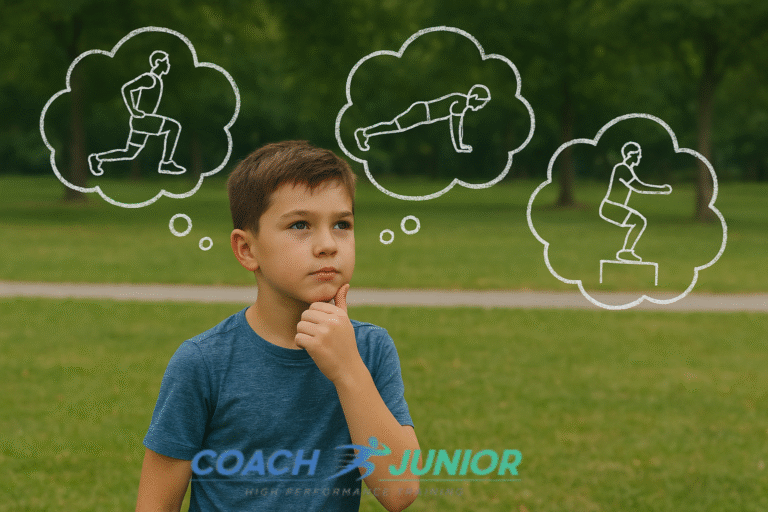
Before weights, kids master bodyweight strength: squats to a box, split-stance step-ups, glute bridges, and plank variations. These build robust cores and hips — critical for sprinting and cutting.
Progression: bodyweight → band-assisted → light external resistance (only when movement competency is solid).
Speed, agility & coordination
Short accelerations (5–20 m), reactive games (coach calls left/right), and ladder drills teach neuromuscular control. This training builds the quickness that matters in games.
Power & plyometrics — done safely
Plyometrics are powerful tools when used carefully: low-volume, technique-focused jumps (stick the landing, soft knees) and medicine ball throws. Coach Junior keeps volume low, emphasizes landing mechanics, and scales intensity by age.

Sample session templates (by age)
Each template below fits common SF spaces (apartment living room, local park, school yard).
Quick 30-minute session (ages 7–10)
Warm-up (5 min): Animal walks, high knees, butt kicks
Movement game (10 min): Cone obstacle course (balance + hopping)
Strength circuit (8 min): 2 rounds — box squats, push-ups on knees, single-leg balance holds
Cool-down (7 min): Short stretch + breathing game
45-minute sport-ready session (ages 11–14)
Warm-up (8 min): Dynamic drills (A-skips, lateral shuffles)
Strength block (15 min): 3 exercises, 3 sets — goblet squat (light), band rows, glute bridges
SAQ (12 min): 6 x 10–15 m accelerations + reactive cone drills
Mobility/cool-down (10 min): Hip and ankle mobility, breathing
60-minute performance block (ages 15–17)
Activation (10 min): Movement prep + sprint technique drills
Strength (30 min): Squat pattern, hinge pattern, push/pull, core stability (moderate load)
Speed/power (12 min): Flying sprints, medicine ball throws
Recovery (8 min): Mobility + de-load talk
4-week starter plan — get your kid moving in SF neighborhoods
A short, consistent starter builds momentum.
Week-by-week focus & sample workouts
Week 1 — Movement literacy: Short sessions (30 min). Focus: landing, hip hinge, single-leg balance.
Week 2 — Build basic strength: Add bodyweight strength circuits 2x per week plus a play day.
Week 3 — Introduce speed work: Short accelerations and agility games, continue strength.
Week 4 — Test & celebrate: Simple tests (10 m sprint, standing broad jump) and a “skills festival” at a local park (Dolores Park or Marina Green).
Coach Junior recommends 2–3 sessions/week plus extra active play (bike rides, catch). Keep sessions fun and measurable.
Safety first: screening, loads, and red flags
Kids may feel sore after sessions — that’s normal. Pain, limping, or persistent discomfort is not.
What to watch for: pain vs. soreness
Soreness: Mild, improves over 48–72 hours, related to muscle use.
Pain: Sharp, joint-based, limits activity — stop and evaluate.
If pain persists >72 hours or is joint-focused, pause training and consult a pediatrician or sports physiotherapist.
Overtraining signs & recovery strategies
Overtraining in kids looks like unusual fatigue, mood changes, sleep disruption, or decreased performance. Countermeasures: reduce volume, prioritize sleep, increase nutrient intake (protein + carbs), and schedule rest days. Coach Junior programs include automatic recovery weeks after 3–4 weeks of progressive load.
Equipment & space: minimal gear, maximum results
You don’t need a gym.
Best gear for in-home and park sessions
Cones or markers (or small toys)
Mini medicine ball (2–4 lbs)
Resistance bands (light/medium)
Small plyo/soft box or sturdy step
Stopwatch or phone for timing sprints
Coach Junior builds sessions around common household objects so families don’t need expensive equipment.

How to measure progress — fun, simple metrics
Tracking builds motivation.
Movement checks, skill wins, and confidence scales
5–10 m sprint time: Quick measure of acceleration
Standing broad jump: Simple power test
Single-leg balance hold: Stability measure
Movement screen pass/fail: Squat, hinge, lunge, push assessments
Confidence scale: Ask your kid to rate confidence 1–10 after sessions
Re-test every 4 weeks and celebrate improvements — big or small.
Why San Francisco is great for youth conditioning
SF’s parks and community spaces make it easy to train outdoors and keep sessions engaging.
Neighborhood-friendly spots: Dolores Park, Golden Gate Park, Marina Green
These locations are perfect for sprint work, group drills, and family-friendly training days. Coach Junior often schedules small-group workshops at these parks — convenient, scenic, and motivating for kids.
Weather, safety, and scheduling tips for SF parents
SF microclimates mean layers are your friend — warm-up properly and bring a windbreaker. Aim for early evenings or weekend mornings to avoid crowds and pick the flattest turf area in the park for safer running.
Parent playbook — how to support your child between sessions
Home habits, nutrition basics, and active rest
Home habits: Encourage 8–10 hours sleep for school-age kids; maintain consistent wake/sleep times.
Nutrition basics: Balanced meals with protein (eggs, beans), carbs (rice, bread, fruit), and healthy fats. Post-session snack: banana + yogurt or a sandwich.
Active rest: Family walks, bike rides, or light play to encourage movement without load.
Coach Junior shares quick weekly homework — 5–10 minutes of focused practice — so parents can support progress without scheduling burnout.
Why Coach Junior’s “in San Francisco” program stands out
Coach Junior combines local convenience with measurable development. The program focuses on:
Science-backed progressions (movement first, load second)
Playful coaching voice that keeps kids engaged
Flexible delivery (in-home, park, virtual) that fits SF family rhythms
Clear metrics to show progress in weeks, not months
Real stories, quick wins, and measurable change
Parents see quick wins: faster short-sprint times, steadier landings, and more confidence. Coach Junior packages these wins into small, digestible reports so families can see the return on time invested.
Conclusion
Sports conditioning for kids SF is not about grinding extra practice; it’s about teaching the body to move better so skills translate to performance and longevity. In San Francisco, where parents juggle busy schedules and value evidence-based choices, Coach Junior’s in-home, park, and virtual programs deliver convenience, safety, and measurable improvement. Start with movement literacy, add strength and speed responsibly, and prioritize recovery — and you’ll watch your child become not only a better athlete, but a more confident one, too.
FAQs
What makes Coach Junior different from a regular sports coach in San Francisco?
Coach Junior focuses on development-first conditioning (movement, strength, speed) delivered in-home, at local parks, or virtually. The emphasis is on safe progressions, measurable outcomes, and a playful coaching voice parents and kids trust.
How often should my child train with Coach Junior?
Typically 2–3 sessions per week plus active play. Younger kids benefit from shorter, frequent sessions; teens can handle longer, more intensive blocks with proper recovery.
Do I need equipment for sessions?
No. Coach Junior designs sessions using minimal gear — cones, bands, a small medicine ball, and household objects — so families can train anywhere in San Francisco.
Is strength training safe during growth spurts?
Yes, when supervised and technique-focused. Coach Junior reduces load and emphasizes movement quality during growth spurts to protect developing joints.
Can Coach Junior help my child prepare for tryouts or a season?
Absolutely. Programs are tailored to the sport and age of the athlete, with specific blocks for speed, power, and endurance designed to peak performance close to tryouts or season start.