
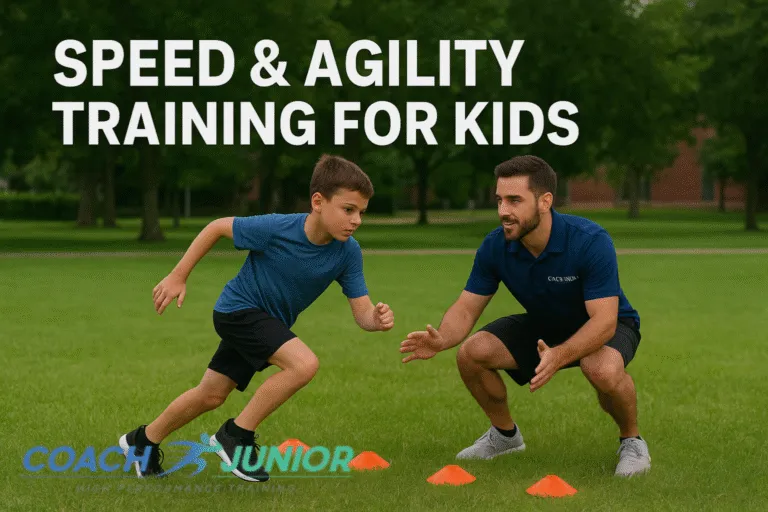
Speed & Agility Training for Kids SF | Make Kids Faster
If you want your kid to move faster, change direction with ease, and play with more confidence, speed and agility training is the missing piece. It’s not about forcing kids to sprint until they drop — it’s teaching the body how to accelerate, decelerate, and react with control. Think of it like upgrading a bike from training wheels to gears: the fundamentals stay the same, but the kid gets more control, speed and confidence.
Here at Coach Junior I focus on safe, age-appropriate, and fun sessions — whether that’s in-home, in a local San Francisco park, or at a small neighborhood group session. My priority is movement quality first, measurable progress second, and fun always.
Why Speed & Agility Matter for Kids
Speed and agility are foundational athletic skills that support nearly every sport and a lot of everyday movement. They help kids run faster, cut cleaner, keep their balance, and react quicker to the unexpected — whether that’s a ball, a teammate, or a suddenly slippery patch of grass
Physical benefits: strength, coordination, and speed
When kids train speed and agility properly they develop:
Explosive strength — better first steps and stronger push-offs.
Coordination & balance — smoother footwork and fewer awkward landings.
Improved sprint mechanics — better posture, arm drive, and efficient foot strike.
These gains come mostly from improved neuromuscular control (better brain↔muscle communication) and bodyweight strength at younger ages — not from heavy lifting. The result? Faster, more controlled movement and a lower risk of awkward falls or movement-related injuries.
Mental and social benefits: confidence, focus, teamwork
Beyond the body, speed and agility workout builds:
Confidence — kids see tangible improvement (quicker first steps, cleaner turns) and that boosts self-image.
Focus & reaction time — reactive drills train attention and quick decision-making.
Teamwork & sport-smarts — many agility activities are social (relays, paired reaction games), which builds communication and cooperative play.
You get physical progress and life skills — a double win.

Who Should Do Speed & Agility Training? (Age & Readiness)
Almost every child can benefit, but the approach must match the age and maturity.
Ages 6–8: play-based movement
For younger kids keep it playful. Short tag games, obstacle courses, ladder footwork and basic balance challenges are perfect. Sessions should be brief (10–20 minutes) and focused on variety — motor skills develop best through play.
Ages 9–12: skill mechanics and foundations
This is a golden window to teach technique. Introduce short sprints (10–20 m), change-of-direction drills, and bodyweight strength. Emphasize the how (posture, arm action, plant mechanics) rather than the how fast.
Ages 13+: sport transfer and measured progress
When puberty hits, kids can handle more structured, measurable programming: sprint sets with controlled rest, progressive plyometrics, and strength work tailored to their sport. Track progress with timed tests and movement checklists.
Coach Junior’s Approach (Local, In-Home & Park-Based Training in San Francisco)
I design programs that fit your child’s age, schedule, and the realities of San Francisco living — short commutes, layered weather, and limited backyard space. My sessions mix skill teaching, fun games, and simple metrics so parents see both the smile and the numbers.
Personalized coaching vs generic class
Generic group classes can be fun, but they often miss the individual movement faults that slow progress. I start with a quick movement screen and a short baseline test (e.g., 10m sprint + basic agility), then tailor drills to the child’s needs. This way we correct the mechanics that actually limit speed — not just repeat drills.
Small groups, in-home sessions, and neighborhood parks
I offer:
1:1 in-home sessions — perfect for busy SF families who want convenience and focus.
Small group neighborhood sessions — 2–4 kids, similar ages/levels, good for social learning.
Park-based coaching — Golden Gate Park, Crissy Field, and neighborhood greens (see park notes below). Training in local parks means we can use real-world surfaces and distances. When appropriate we pick flat, safe stretches for sprints and soft grass for hops/jumps. (Local park details and safety notes follow below.)
Core Components of a Kids Speed & Agility Session
Every session balances warm-up, technical work, reactive drills, and recovery. Here’s the standard flow I use.
Warm-up & mobility
We start with dynamic movement: skips, leg swings, ankle mobility, carioca, and hip openers. Warm-ups prime the nervous system and reduce injury risk. I keep it active and playful — kids respond better when a warm-up feels like a game.
Acceleration & top-speed mechanics
Short sprints (3–20 m) with technique cues: low first step, chest over front knee, and strong arm drive. For kids we train acceleration more than maximal velocity — it’s what helps them in games and short-field situations.
Change of direction & deceleration
We practice planting mechanics and absorbing force — learning to “slow in, explode out.” Drills include zig-zag cones, 5-10-5 shuttles and short cutting drills with emphasis on small, controlled steps.
Footwork drills & coordination (ladders, cones)
Agility ladders and cone drills build rhythm and foot speed. Progressions move from two-feet-in-each-box patterns to lateral and diagonal steps, finishing with sport-specific footwork.
Reaction drills & decision-making games
Quick cue-based games (visual or auditory prompts) teach kids to make choices under pressure — the same skill they use during a soccer scramble or basketball play.
Cool-down & recovery
Short walk, light stretching, and a conversation about what went well. I also track perceived exertion (simple kid-friendly scale) so training load stays appropriate.

Sample 45-Minute Session (Step-by-Step)
Here’s a plug-and-play 45-minute session I use with kids aged ~9–12. Perfect for a local park or a backyard with a bit of space.
1. Warm-up (8 minutes)
Light jog 1–2 minutes, dynamic mobility 4 minutes (high knees, butt kicks, leg swings), quick activation game (e.g., “freeze” sprints).
2. Acceleration work (8 minutes)
3 × 10 m falling starts (full recovery between reps).
3 × 20 m controlled sprints focusing on posture.
3. Footwork station (8 minutes)
Ladder drills: two-in-each, lateral shuffle, one-leg hops (rotate 45s on/15s rest).
4. Change-of-direction (8 minutes)
Cone zig-zag repeat (4 runs), 5-10-5 shuttle x3 with coaching cues.
5. Reactive game (6 minutes)
Coach points left/right; child accelerates to correct cone—winner gets to choose next game.
6. Cool-down & debrief (5 minutes)
Light walk, calf/hamstring stretch, one positive takeaway and one small technical cue for next time.
This session balances intensity and recovery, keeps coaching cues simple, and finishes with positive reinforcement.
Simple Tests & Progress Metrics (10m sprint, Pro-Agility)
Measuring progress is key to motivation. Two simple tests I use:
10 m (or 10-yard) sprint: time the first 10 m from a standing start. It’s an easy baseline for acceleration.
Pro-Agility (5-10-5) shuttle: classic change-of-direction test — sprint 5 yards right, 10 yards left, then 5 yards back to center. Time from start to finish.
How to test safely at home or at the park
Use cones or towels as markers.
Ensure a flat surface (tarmac path or short grass).
Warm up thoroughly first.
Do 2–3 trials with full rest; record the best time.
Never test after fatigue or heavy practice — baseline tests are most valid when fresh.
How to read results and set goals
Small improvements matter: shaving 0.1–0.2s off a 10m time is meaningful for kids. Set short-term process goals (clean first step, lower body lean at drive phase) and measure every 4–6 weeks. Celebrate technical wins (better posture, smoother cuts) even when times are steady — neuromuscular changes often precede big time drops.
A 4-Week Beginner Plan (Ages 8–12)
A simple, progressive 4-week plan — 2 sessions per week. Keep sessions short (25–35 minutes).
Week-by-week drills and goals
Week 1 — Foundation (Goals: movement quality & fun)
Session focus: dynamic warm-ups, 3-step accelerations, ladder two-in drills, basic cone zig-zag.
Goal: learn the correct first step and keep knees soft on cuts.
Week 2 — Build (Goals: rhythm & controlled cuts)
Session focus: add 10–20 m sprints (tech only), 5-10-5 intro, lateral ladder patterns, single-leg hops.
Goal: clean 5-10-5 technique (slow in, explode out).
Week 3 — React & Combine (Goals: decision-making & transfer)
Session focus: reaction games, drill combinations (ladder → sprint → cone cut), light plyo hops.
Goal: quicker reaction to coach cues, better flow between drills.
Week 4 — Test & Consolidate (Goals: baseline tests & confidence)
Session focus: re-test 10 m & pro-agility, review technique, game-based challenge.
Goal: measurable improvement (even small), visible confidence boost.
Small, consistent steps add up — and keeping it playful keeps kids coming back.

Safety, Load Management & Injury Prevention
Kids need volume control and smart progressions more than harder workouts.
Warm-up importance and landing mechanics
Landing mechanics are huge — teach kids to land softly with knees tracking over toes and hips back. Warm-ups prime the joints and nervous system, reducing injury risk.
Signs of too much training (overtraining in kids)
Watch for:
Persistent fatigue or irritability.
Declining performance despite training.
Frequent soreness that doesn’t recover in a few days.
If any of these appear, scale back and prioritize rest — kids recover differently than adults.
Equipment, Space & Where to Train in San Francisco
You don’t need fancy gear — but a few items make training easier and safer.
Minimal gear list
Cones (6–12)
Agility ladder or tape to mark squares
Stopwatch or phone
Comfortable sneakers (not brand-new slippery soles)
Best neighborhood parks & safe surfaces in San Francisco
Some favorite local spots where I run sessions:
Golden Gate Park (Great Meadow zones) — wide, flat spaces.
Dolores Park (early mornings on the grass) — central and social.
Marina Green — flat, open turf with water views.
Presidio playing fields — quieter and well-kept.
Always check turf consistency and avoid wet slippery surfaces.
Why Local Matters: Benefits of Training with a San Francisco Coach
Neighborhood knowledge, weather, and tailored scheduling
A local coach understands microclimates (fog at sunrise, chill from the bay), which neighborhoods have flat stretches, and when parks are least crowded. That saves time and makes sessions predictable for busy families.
Community, micro-testimonials, and trust
Local coaches build relationships: parents swap success stories, neighborhoods provide referral opportunities, and small-group sessions create accountability. A coach who trains in your neighborhood also becomes easier to trust — you see them regularly, you know where they coach, and you get local references.
How to Book (Practical CTA for Coach Junior)
Ready to try a focused, fun session for your kid in San Francisco? Book a free 15-minute phone consultation or a trial 30-minute session. I’ll do a quick movement check, set one immediate technical goal, and map out a 4-week plan tailored to your child’s schedule and neighborhood.
Conclusion
Speed and agility training for kids is about teaching reliable movement — not forcing volume or obsessing over stopwatch times. Done right, it improves strength, coordination, confidence, and decision-making. In a city like San Francisco, local knowledge — park choice, microclimate timing and convenient in-home options — makes training practical and effective. Whether you want a short in-home session or park-based small group coaching, the goal is the same: better movement, more confidence, and a lifelong love of play.
FAQs
How often should my child train speed & agility?
For most kids, 1–2 focused sessions per week (20–45 minutes) paired with regular play and sports is ideal. Rest and fun are part of the program.
Can we test progress at home without fancy equipment?
Absolutely — mark 10m and use a phone timer for sprints, and use cones or towels for a 5-10-5 shuttle. Warm up first and do 2–3 trials.
What if my kid hates running in a straight line?
Perfect — we’ll emphasize reaction games, ladder footwork, and sport-like scenarios so training feels like play, not punishment.
Is artificial turf okay for training?
Turf is fine for many drills but has trade-offs (heat, environmental concerns). For repeated jumping I prefer well-maintained natural grass; for consistent sprint times a flat paved promenade is better. Recent local debates around turf show community concerns — so choose surfaces thoughtfully.
Which San Francisco parks are best for sprinting and drills?
Golden Gate Park and its Polo Fields/Kezar areas are versatile for drills; Crissy Field and Marina Green provide flat promenade runs; neighborhood parks (Alamo Square, Dolores Park) work well for small groups and footwork. Choose less-crowded times and flat stretches for testing.