
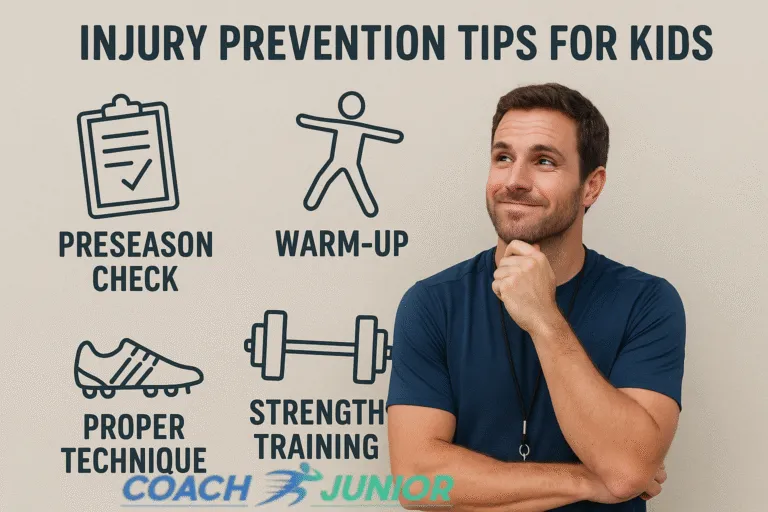
Injury Prevention Tips for Kids in Sport — San Francisco Coach-Approved
Hey San Francisco parents — let’s get straight to it. Sports should build confidence, fitness, and lifelong habits, not pain, missed seasons, or long-term problems. This guide delivers clear, coach-approved injury prevention tips for kids in sport you can use today — whether you coach at Golden Gate Park, run practices at Crissy Field, or just want safer backyard play.
Why injury prevention matters for growing bodies
Kids aren’t small adults. Their bodies are dynamic, unpredictable, and, at times, frustratingly fragile. Understanding the biology behind that fragility helps parents and coaches make safer decisions.
Growth plates, coordination and risk
Growth plates (physes) are the soft areas at the ends of growing bones. They’re responsible for lengthening bones during childhood and adolescence, but because they’re not fully mineralized, they’re also more prone to injury than the rest of the bone. During growth spurts a child’s limbs can lengthen faster than muscles and tendons adapt, which temporarily reduces coordination and increases injury risk.
Practical takeaways:
Expect clumsiness during growth spurts — reduce high-impact volume for a few weeks if coordination drops.
Avoid heavy, repetitive loading on immature bones (e.g., excessive pitching or long-distance running without appropriate progression).
Prioritize movement quality: teach how to land, decelerate, and change direction safely.
Overuse vs. acute injuries
Acute injuries happen in a single event — an ankle twist, a collision, a fall. They’re often obvious: sharp pain, swelling, immediate inability to continue.
Overuse injuries develop gradually from repeated micro-stress: tendonitis, stress reactions, Osgood-Schlatter growth-plate irritation. They start as nagging soreness and, if ignored, become season-breakers.
Key rule: if pain persists or increases despite rest, it’s not “just growing pains” — take action early.
Core principles of injury prevention for kids in sport
Before drills and checklists, internalize three simple principles that shape everything a coach or parent does.
Principle 1 — Age-appropriate training
Match the training to the child’s developmental stage. For young kids, the focus is play, balance, and basic movement skills. For older teens, gradually introduce structured strength and sport-specific mechanics. Keep sessions short and fun for littles; be methodical and progressive for teens.
Principle 2 — Variety beats specialization early
Early single-sport specialization (year-round) increases overuse injuries and burnout. Encourage multi-sport play and cross-training to develop a broad athletic base — agility from soccer, upper-body strength from swimming, balance from gymnastics. Variety builds durable bodies.
Principle 3 — Listen to the body (communication)
Create a culture where kids report pain, fatigue, or dizziness without fear. Normalize early reporting: “Tell me if it hurts more than normal after practice.” Teaching kids to self-monitor helps catch problems when they’re small and easily fixable.

10 Coach-Approved Injury Prevention Tips for Kids
Below are ten bite-sized, coach-tested actions you can start using today. Each one is practical, repeatable, and designed to fit into family life in San Francisco.
Tip 1: Start with a preseason check & baseline screening
A quick preseason screen saves headaches. You don’t need a fancy clinic — just a baseline:
Single-leg balance (30 seconds each side)
Basic squat depth (do they squat pain-free through full range?)
Short run & stop (notice knee alignment)
Questions: past injuries, current complaints, sleeping patterns
If anything looks off, schedule a brief check with your pediatrician or a sports PT. A baseline makes it easy to see if something changes mid-season.
Tip 2: Warm up like a pro — a 6-minute coach’s dynamic routine
Forget static stretching first — dynamic movement wakes the muscles and nervous system. Here’s a simple 6-minute routine I use in San Francisco parks before practices or games:
Light jog or brisk walk — 60s. (Get the heart pumping.)
Leg swings front-to-back & side-to-side — 30s each leg. (Loosens hips.)
Walking lunges with arm reach — 60s. (Open the hip flexors and activate the core.)
High knees 30s / butt kicks 30s. (Foot turnover and hamstring prep.)
Mini-bounds or skip hops — 60s. (Practice soft landings and spring.)
Agility steps / lateral shuffles — 60s. (Light change-of-direction prep.)
Do this before any intense activity especially on slick grass (common in SF mornings). The dynamic warm-up primes the movement patterns you’ll use in sport and reduces muscle strain risk.
Tip 3: Strength and stability — the kid-friendly circuit
Strength builds resilience. Use bodyweight progressions and fun names so kids enjoy it:
Single-leg balance with reach — 30s/side. (Improve ankle/knee stability.)
Step-ups on a low bench — 8–10 reps/leg. (Functional strength.)
Bear crawls 10-20 meters — full-body control.
Side-lying clams or banded monster walks — 10–15 reps (hip stability).
Wall sit 20–30s — quad endurance.
Do 2 rounds, twice per week. Increase difficulty slowly: more reps, slower tempo, or small weights only after technique is flawless.
Tip 4: Teach safe landing, cutting, and fall mechanics
We can’t avoid falling — but we can teach how to fall safely and land softly.
Key landing cues:
Knees bent, soft on contact — “land like a whisper”.
Hips back, chest over knees — absorb with the hips, not the knees.
Feet shoulder-width, toes forward, eyes looking ahead.
Drills:
Jump-land-hold — jump from low box, land, hold 2 seconds.
Cone cut at low speed — focus on plant and push, not twisting.
Partner tackle-and-roll practice (contact only when age-appropriate).
For younger kids, make drills into games: “who can land the softest?” Positive reinforcement beats jargon.
Tip 5: Monitor load — how much is too much?
Track total hours of sport per week and variety. A practical guideline: avoid having weekly hours in a single sport exceeding the child’s age (not a hard rule, but a useful red flag). So, a 12-year-old playing 12+ hours per week of competitive baseball is at increased risk.
More important: watch for sudden jumps in volume. If a kid goes from 2 practices to 6 per week, scale up intensity gradually.
Also schedule at least one complete day off per week and a multi-week break after the season.
Tip 6: Cross-train to balance the body
Alternate movement types weekly:
Strength or gymnastics session Tuesday
Swim or bike on Thursday (low impact)
Sport practice Saturday
Cross-training maintains fitness and helps weaker muscle groups catch up. It’s also fun — and fun keeps kids engaged.
Tip 7: Gear, shoes, and field checks (wear the right armor)
Never underestimate proper gear:
Shoes: replace worn cleats or running shoes when the sole is uneven or cushioning is gone.
Protective gear: helmets, mouthguards, shin guards — fit matters more than brand.
Fields: before play, do a quick sweep: holes, rocks, glass, uneven turf. In San Francisco check for wet grass in the Presidio or heat on artificial turf.
Bad shoes + slick surface = higher twist/sprain risk. Fix the simple things first.
Tip 8: Hydration, sleep, and nutrition for recovery
Recovery is where injuries are prevented long-term.
Hydration: sip fluids before, during, and after practices — not a single big gulp. For long sessions, include electrolyte options.
Sleep: kids need lots of sleep. Age-based targets: elementary (9–11+ hrs), middle school (8–10 hrs), teens (8–9 hrs). Sleep boosts tissue repair and focus.
Nutrition: focus on whole foods — lean protein for repair, carbohydrates for energy, fruits and veggies for micronutrients. Small post-practice snacks with protein help recovery.
A tired, thirsty kid has slower reaction times — which makes injury more likely.
Tip 9: Long breaks and off-season planning
Plan a true off-season: 4–8 weeks per year away from the primary sport, mixing in light, fun activities. Use the off-season to address weaknesses: flexibility, general strength, and movement quality. Come back refreshed and less injury-prone.
Tip 10: Recognize red flags — when to stop and see a doctor
Don’t ignore these signs:
Inability to put weight on a limb
Swelling or obvious deformity
Numbness, tingling, or weakness
Pain that wakes the child at night or persists >48 hours
Any sign of concussion (confusion, vomiting, severe headache, balance problems)
If in doubt, stop playing and get a professional opinion. Early management often avoids lengthy downtime.

Sample 20-minute injury-prevention session you can do in any SF park
This is a compact session perfect for before practice or a short one-on-one coaching block.
Warm-up (6 minutes)
1 minute: light jog or brisk walk around the field.
1 minute: leg swings (front/back) and arm circles to mobilize hips and shoulders.
1 minute: walking lunges with a reach overhead — rhythm and range.
1 minute: high knees / butt kicks combo (30s each) for quick feet.
1 minute: mini-bounds — focus on soft landings.
1 minute: lateral shuffles and quick stops — low-intensity change of direction.
Strength & stability (10 minutes) — 2 rounds
Single-leg balance with reach — 30s each leg.
Step-ups — 8–10 reps each leg on a park bench.
Bear crawls — 20 meters out and back.
Side plank (modified) — 20s each side or 8–10 reps of clam shells if younger.
Wall sit — 30s to tax muscular endurance.
Keep rest short (20–30s) between sets. Focus on clean movement.
Playful finish & cool-down (4 minutes)
Soft-landing challenge — 3 low jumps; kids score for the quietest landing.
Walk and stretch — 2 minutes of gentle quad and calf stretches. Emphasize breathing and hydration.
This session is coach-bookable as a 20-minute module — perfect for busy SF families between work and dinner.
Bringing injury prevention to San Francisco families
Localizing advice increases relevance and conversions. Here’s how to apply these tips in the SF context.
Parks & spaces we coach in (Golden Gate Park, Crissy Field, the Marina)
Each park has its own micro-climate and surface quirks:
Golden Gate Park: big grassy areas — great for running and jumps but watch for morning dew.
Crissy Field: sandy patches and wind — great for strength and balance drills, less ideal for sharp cuts on windy days.
The Marina: flatter surfaces and proximity to water — watch the sun glare and choose shaded times.
Knowing the park helps you choose drills: balance work on slippery grass, agility on drier turf, and sand for low-impact resistance.
How local weather and surfaces change your plan
SF fog and damp mornings increase slip risk; reduce cutting drills and emphasize balance. On hot, sunny days (less common but possible), shorten sessions and increase hydration. Artificial turf heats up quickly — consider shoes with adequate grip and plan water breaks.
How Coach Junior books an in-park session in San Francisco
We offer short, focused modules — a 20-minute injury-prevention block fits between school pickup and dinner, is easy to book online, and can be delivered in parks across the city. Local parents appreciate the convenience of coach-led micro-sessions that deliver measurable improvements without a huge time commitment.

Common myths & mistakes parents make
Myth: “If they can play, they’re fine.”
Not true. Kids often play through pain because they don’t want to disappoint teammates or parents. Normal play soreness is brief and improves with rest; persistent pain is not normal. Encourage reporting and treat pain as a cue, not a badge of honor.
Myth: “Strength training is for older kids only.”
False. Age-appropriate strength (bodyweight, play-based) is safe and protective for young children. The goal is movement quality and fun, not heavy lifting. Stronger muscles stabilize joints and reduce injury risk across ages.
Conclusion
Keeping kids safe in sport doesn’t require complicated protocols — it requires consistent small actions: smart warm-ups, basic strength, thoughtful load management, and a culture that listens to the body. For families in San Francisco, minor tweaks — like adjusting drills for foggy, wet grass or booking short in-park modules — make a big difference. Use these injury prevention tips for kids in sport as your coaching checklist, and you’ll help kids play harder, smarter, and longer.
If you want, Coach Junior can turn this plan into a printable checklist, film short demo clips for your parents, or book a 20-minute in-park session to implement it live in San Francisco.
FAQs
How often should kids do injury-prevention strength work?
Twice per week is a great target. Short, consistent sessions (15–20 minutes) deliver better results than infrequent long workouts.
Can warm-ups really reduce serious injuries like ACL tears?
Proper neuromuscular warm-ups and landing training reduce risk factors linked to ACL injuries. They don’t make injuries impossible, but they shift the odds in your child’s favor when done regularly.
My child complains of “growing pains” — should I worry?
Growing pains are common, but persistent localized pain, swelling, or limping should be evaluated. When in doubt, rest and consult a pediatrician or sports PT.
Are resistance bands safe for kids?
Yes — resistance bands are excellent for introducing progressive strength work with low impact. Use light resistance and prioritize technique.
When can a child return to play after a sprain?
Return-to-play should be gradual and pain-free; start with daily activities, then non-contact training, followed by progressive intensity and finally full games. If swelling or pain persists, seek professional clearance.